

Credit card reconciliation is the process of matching every transaction on a corporate card statement to the entries in your general ledger or subledger. It confirms that what the card issuer says you spent is exactly what your books recorded, no more and no less. For enterprise finance teams running card programs across multiple entities, this single check protects against fraud, keeps the close on schedule, and gives auditors a clean trail to follow.
A quick overview: this guide covers how the reconciliation process works step by step, the best practices that keep it fast at scale, the challenges that slow enterprise teams down, and how automation changes the equation.
What Is Credit Card Reconciliation?
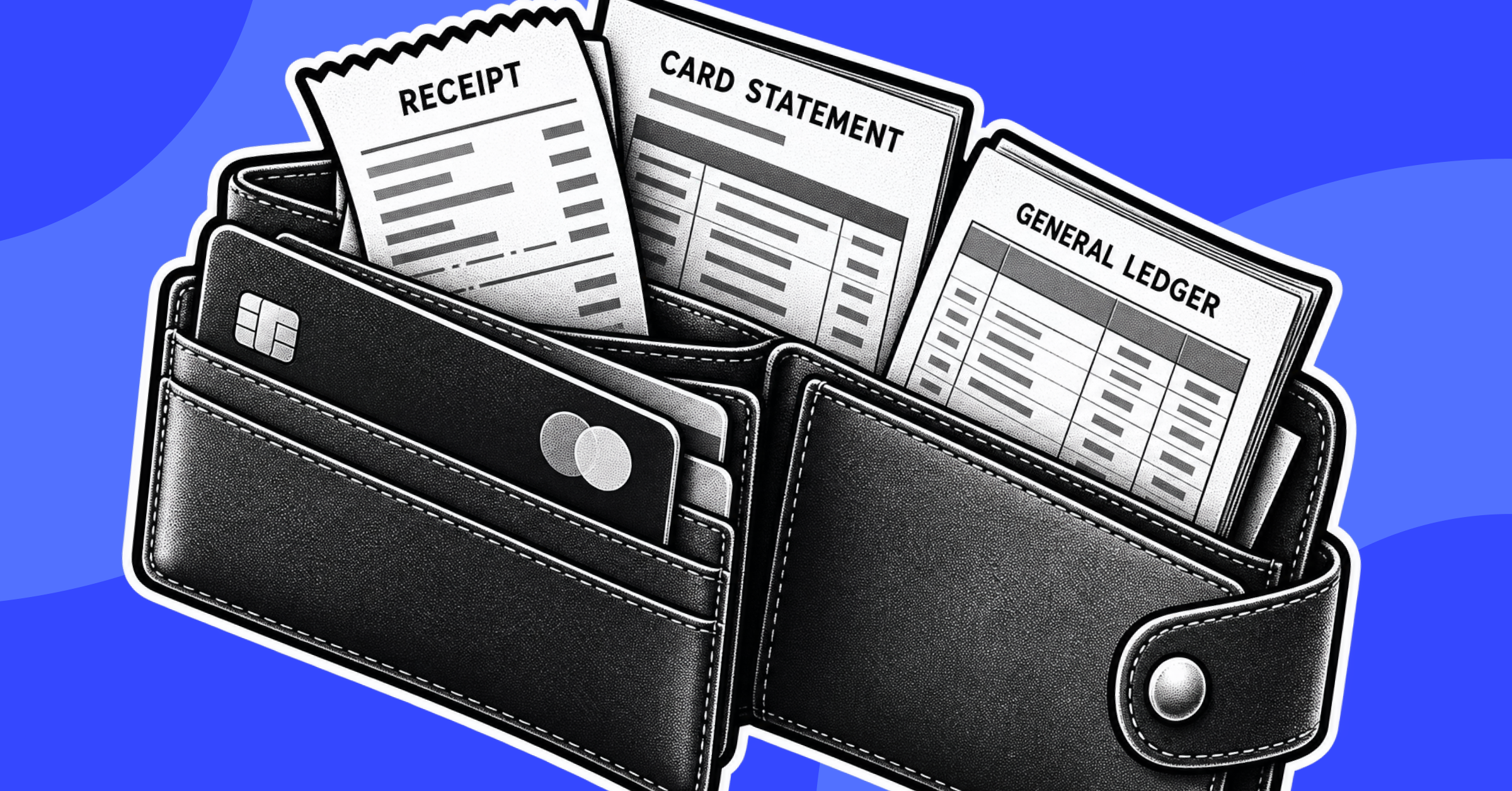
Credit card reconciliation compares the transactions listed on a corporate credit card statement against the corresponding entries in your general ledger or expense subledger. If every charge on the statement has a matching, correctly coded entry in your books, and every entry in your books has a matching charge, the account reconciles.
This is different from expense-report reconciliation, which checks that an employee's submitted receipts match their card charges for reimbursement or policy compliance. Credit card reconciliation, as covered here, is a financial close control: it confirms the card issuer's data matches what's posted to the GL, independent of whether receipts were ever collected.
For enterprise finance teams, this usually touches multiple card programs (procurement cards, travel cards, department-level cards) across multiple entities and currencies, feeding into the same month-end close that reconciles bank accounts, vendor balances, and intercompany transactions. It's one of several types covered in our broader guide to account reconciliation.
Why Credit Card Reconciliation Matters
- Catches errors before they compound: Duplicate charges, wrong currency conversions, and data entry mistakes are easy to miss one at a time, but they distort account balances if left unresolved across a full statement cycle.
- Prevents fraud: Debit and credit card fraud remains the most commonly reported payment fraud type among financial institutions, according to the Federal Reserve's 2026 Risk Officer Report (Federal Reserve Financial Services). Unreconciled card accounts are exactly where unauthorized or duplicate charges go unnoticed longest.
- Keeps the close audit-ready: Every reconciled statement becomes documented proof for auditors that card spend was reviewed and approved, which matters more as card programs grow.
- Protects cash flow visibility: Commercial card programs are increasingly used by CFOs as a control instrument, not just a payment method, according to Visa's 2025/2026 Growth Corporates Working Capital Index reported by PYMNTS (PYMNTS). Unreconciled card spend hides real-time cash position, which complicates forecasting for any enterprise managing working capital across entities.
How Credit Card Reconciliation Works
The process breaks down into five steps:
- 1. Gather Statements: Collect the credit card statement for each card and program for the period, along with the corresponding GL extract or expense subledger. For multi-entity enterprises, this means pulling data across every issuer and every legal entity separately before matching begins.
- 2. Match Entries: Compare each statement line to its GL entry by amount, date, merchant, and account code. Most charges match automatically when data formats are consistent; high-volume programs generate hundreds or thousands of these matches per cycle.
- 3. Identify Discrepancies: Flag anything that doesn't match automatically. This includes missing entries, duplicate charges, timing differences (a charge posted on the statement but not yet in the GL), and coding errors.
- 4. Resolve Gaps: Investigate each flagged item. Confirm whether it's a timing difference that will clear next cycle, a genuine error that needs correction, or a disputed or fraudulent charge that needs to go to the issuer.
- 5. Close and Document: Once every line item is either matched or explained, sign off the reconciliation and file supporting documentation, statement, GL extract, and exception notes, so the trail is complete for audit.
For example, a 3,200-transaction monthly statement across four regional entities might auto-match 3,100 lines on amount and merchant code alone. The remaining 100 exceptions, duplicate charges, unposted timing differences, and a handful of miscoded entries, are what the finance team actually spends its time on. A high auto-match rate is the difference between a reconciliation that takes an afternoon and one that takes a week.
Best Practices
- Reconcile on a fixed cycle: Monthly at minimum, aligned to your close calendar, so exceptions never span more than one statement period.
- Segregate duties: The person who reconciles the account shouldn't be the same person who approves card spend or codes transactions.
- Set exception thresholds: Route anything above a defined dollar amount, or an unusual merchant category, for manager review before it's cleared.
- Standardize documentation: Every reconciliation should include the same fields, opening balance, closing balance, exception list, explanations, and sign-off, across every entity and card program.
- Reconcile at the program level, not just the card level: For enterprises running multiple card programs, roll up exceptions by program so patterns, like a specific merchant category or a specific entity, are visible, not just individual line items.
Common Challenges and How to Fix Them
- High transaction volume: A single enterprise card program can generate thousands of line items a month. Manual line-by-line matching doesn't scale, automated matching rules handle routine transactions so the team only reviews genuine exceptions.
- Multi-entity, multi-currency card programs: Currency conversion timing and entity-level coding rules multiply the number of ways a transaction can look like a mismatch. Centralizing card data across entities before matching reduces false exceptions.
- Timing differences: A charge appears on the statement before it posts to the GL, or vice versa. A clear cutoff rule, for example anything posted within three business days rolls to the next period, prevents these from being logged as errors.
- Disputed or fraudulent charges: These need to be tracked separately from routine exceptions since they involve the card issuer, not just an internal correction. See our guide on chargeback and dispute rate for how to manage this category specifically.
- Manual spreadsheet risk: Formula errors and version-control issues compound when multiple people touch the same reconciliation file across a multi-entity close.
Manual vs. Automated Credit Card Reconciliation
Manual: Line-by-line matching in spreadsheets, prone to formula and version errors. Exceptions found only after the full statement is manually reviewed. Documentation scattered across email threads and shared drives. Reconciliation time scales linearly with transaction volume.
Automated: Rules-based and fuzzy matching clears routine transactions automatically. Exceptions surfaced and routed the moment they're flagged, not at month-end. Audit trail generated automatically as part of the matching process. Reconciliation time scales with exception volume, not total transaction volume.
KPIs to Track
- Efficiency: Reconciliation cycle time (days from statement close to sign-off), and percentage of transactions auto-matched.
- Accuracy: Exception rate (percentage of transactions requiring manual review), and repeat-error rate by category.
- Audit Readiness: Days outstanding on unresolved exceptions, and percentage of reconciliations with complete supporting documentation.
How Bluecopa's Recon Platform Improves Credit Card Reconciliation
Bluecopa's Samyx Recon agent handles the matching layer directly: it processes more than 5 million records an hour at 97 to 99% accuracy, using a hybrid of deterministic and fuzzy matching, so routine card-to-GL matches clear automatically across every entity and card program instead of one spreadsheet at a time. Instead of a finance analyst manually scanning a full statement for mismatches, only genuine exceptions, duplicate charges, coding errors, disputed transactions, surface for review. Every match, exception, and resolution is logged automatically, which is the documentation auditors ask for anyway.
Enterprise finance teams using Bluecopa for account reconciliation have reported meaningfully faster close cycles: HackerEarth cut reconciliation errors by 60%, and Yatra's AR reconciliation now runs 7x faster with an 80% reduction in manual reconciliation work. The same matching engine applies to high-volume card programs.
Bluecopa is built for enterprise finance teams, controllers, and shared services organizations managing card programs across multiple entities, ERPs, and currencies, not single-entity businesses reconciling one corporate card.
Where this shows up in practice:
- High-volume B2B enterprises running procurement and travel card programs across regional entities, see our Procure-to-Pay platform.
- Multi-entity organizations closing books across multiple ERPs where card data needs to be normalized before matching, see data ingestion.
- Enterprises preparing for audit that need a documented, exception-based reconciliation trail rather than spreadsheet history, see controls and audit trails.
- Finance teams evaluating a move from manual reconciliation to a dedicated platform can also compare options in our credit card reconciliation software guide.
Last Reviewed: September 2026. Credit card reconciliation practices, fraud patterns, and automation capabilities evolve. Confirm current thresholds, documentation requirements, and audit expectations with your internal controls team before changing a live reconciliation process.
Frequently Asked Questions
1. What's the difference between credit card reconciliation and expense report reconciliation?
Credit card reconciliation matches statement charges to the GL as a close control. Expense report reconciliation checks employee receipts against charges for reimbursement and policy compliance.
2. How often should businesses reconcile credit cards?
Most enterprises reconcile monthly, aligned to the close calendar, though high-volume card programs may reconcile weekly to keep exception volume manageable.
3. What causes most credit card reconciliation discrepancies?
Timing differences, duplicate charges, and coding errors account for most discrepancies. Foreign currency conversion adds another common source for multi-entity programs.
4. Can credit card reconciliation be automated?
Yes. Automated matching engines clear routine transactions and surface only genuine exceptions, reducing reconciliation time from days to hours for high-volume programs.
5. Who should perform credit card reconciliation?
A dedicated finance or accounting team member, separate from whoever approves card spend or codes transactions, to maintain segregation of duties.
6. What documentation should a credit card reconciliation include?
Opening and closing balances, the full exception list, explanations for each discrepancy, and a record of who prepared and reviewed the reconciliation.