

Key Takeaways
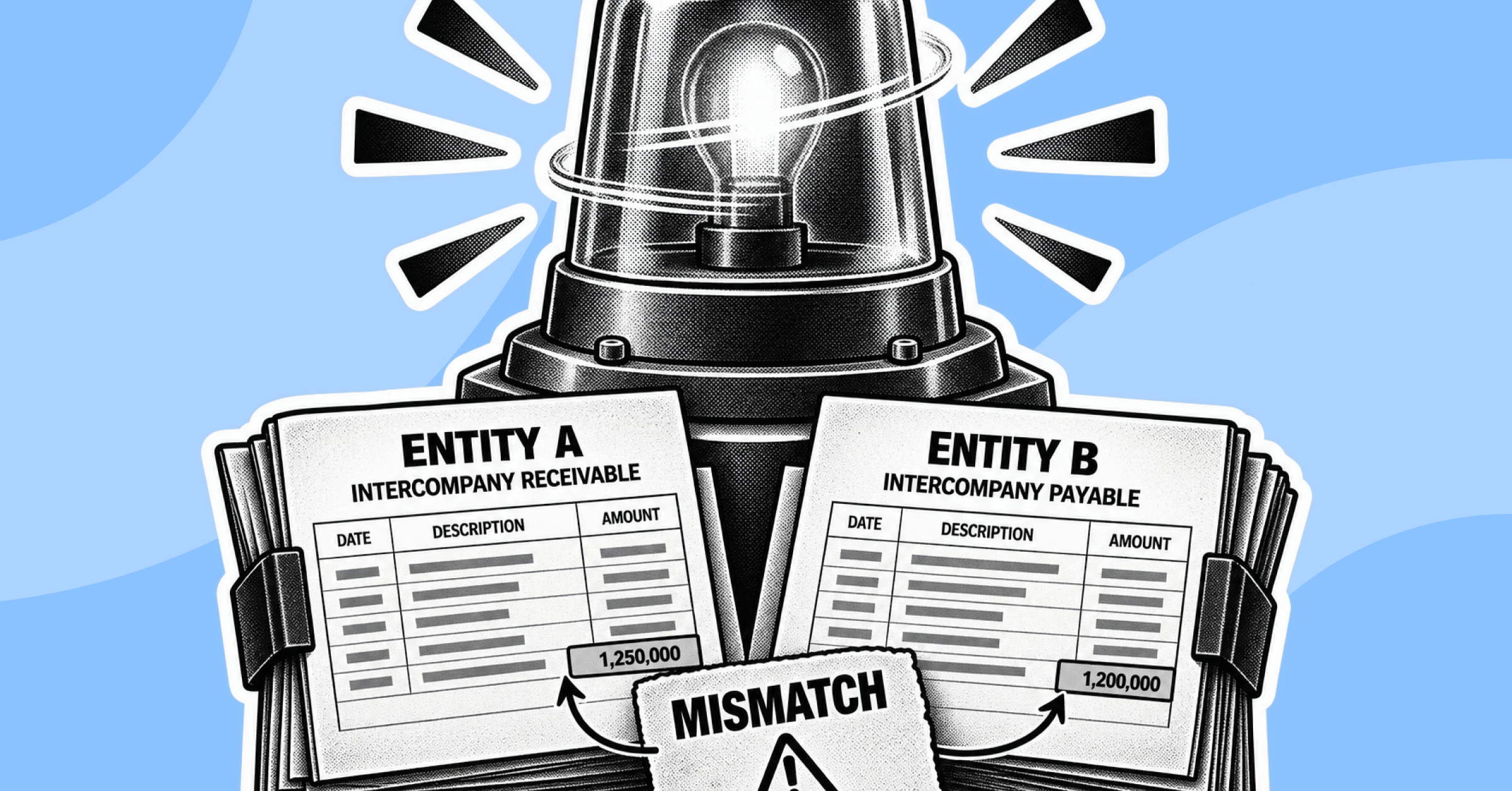
- Unreconciled intercompany balances that persist past two or three close cycles are the single most reliable early warning sign, and they almost always trace back to mismatched timing, currency treatment, or missing documentation rather than one-off errors.
- Recurring disputes and reclassifications between entities point to a process problem, not a people problem: unclear ownership of the intercompany chart of accounts or no shared matching logic between entities.
- Transfer pricing red flags (inconsistent markups, undocumented service charges, one-sided adjustments) are operational warning signs you should watch for, not something to self-diagnose as a tax or legal conclusion.
- Treasury-side symptoms like excessive FX settlement fees or unexplained cash sweeps often originate upstream in accounting: unreconciled balances create unnecessary intercompany funding movements.
- Oversized shared service center (COE) costs and overworked close-period staff are a red flag in their own right, usually caused by manual matching work that scales headcount instead of scaling process.
- Catching these flags before year-end requires continuous, not period-end, visibility into intercompany balances, ownership, and variance.
Most controllers don't find out their intercompany process has a problem from a dashboard. They find out from an auditor, a frustrated regional controller, or a tax authority letter, months after the underlying issue first appeared. By the time a red flag becomes visible at that level, it has usually been compounding quietly for two or three close cycles.
Identifying intercompany red flags early means knowing what to look for in each function that touches intercompany transactions, not just accounting. Treasury, tax, FP&A, AP, and even HR each surface a different symptom of the same handful of underlying problems: unclear ownership, manual matching, and inconsistent documentation between entities.
A quick overview: this guide covers what actually counts as an intercompany red flag versus normal fluctuation, then walks through the specific warning signs to watch for in unreconciled balances, recurring disputes and reclassifications, transfer pricing and tax exposure, treasury and cash movement, shared service center costs, and ownership gaps across departments. It closes with how to catch these flags before they become audit findings and how Bluecopa gives you the continuous visibility to do that.
What Counts as an Intercompany Red Flag
Not every variance between entities is a red flag. Currency translation differences, timing gaps from different close calendars, and small rounding variances are normal in any multi-entity structure. A red flag is a pattern that repeats, grows, or has no clear explanation attached to it.
Three conditions turn a normal variance into a red flag:
- It persists. The same intercompany balance is unreconciled two, three, or more close cycles in a row, rather than clearing in the following period.
- It has no documented explanation. Someone can't point to the invoice, agreement, or policy that justifies the balance, the charge, or the adjustment.
- It's growing, not shrinking. The dollar value, the number of open items, or the time it takes to resolve is trending up, not down, close over close.
If a variance meets even one of these conditions, it's worth investigating before it becomes something an auditor flags instead of something you caught yourself.
Unreconciled and Prolonged Unsettled Intercompany Balances
The most common and most telling intercompany red flag is a balance between two entities that won't reconcile, and stays that way past the close it first appeared in. This is different from a normal in-transit item, which clears within a period or two once both sides record the transaction.
Prolonged unreconciled intercompany balances usually come from one of a few root causes:
- Timing mismatches. One entity books a transaction in the current period, the counterparty books it a period later, often because of different close calendars or manual intercompany invoicing that lags the actual transaction.
- Currency and rate mismatches. Entities apply different FX rates, or one side doesn't revalue the balance at all, so the two ledgers never actually agree even when the underlying transaction is correct.
- Missing or informal documentation. A charge gets booked on one side with no corresponding intercompany agreement or invoice, so the counterparty either doesn't record it or records a different amount.
- Manual, period-end-only matching. When intercompany matching only happens once, at close, small discrepancies pile up for weeks before anyone looks at them, by which point the underlying detail (which invoice, which shipment, which service period) is harder to trace.
Diagnosing this requires more than an aging report. Pull the intercompany balance by counterparty pair, sort by age, and look specifically at how many items are carrying over rather than clearing. A balance that ages past 60-90 days without resolution is the point most controllers treat as a real problem, not a rounding issue.
Recurring Disputes and Unresolved Reclassifications Between Entities
A second category of red flag shows up as friction between entities rather than a static balance: one entity's controller keeps disputing charges from another, or the same items get reclassified quarter after quarter without ever being resolved at the source.
Watch for these specific patterns:
- The same intercompany account is being reclassified in three or more consecutive closes, which usually means the original posting logic was never fixed, only worked around.
- One entity routinely disputes management fee, cost allocation, or shared service charges from a parent or hub entity, particularly when there's no written cost allocation methodology behind the charge.
- Intercompany elimination entries at consolidation require manual investigation every period instead of matching automatically, which signals the underlying entity-level postings aren't consistent with each other.
- Different entities are using different account structures or different currencies of record for what should be the same intercompany transaction type, making true matching (rather than approximate matching) impossible.
The root cause behind recurring disputes is almost always unclear ownership: no single team or system owns the intercompany chart of accounts, the allocation methodology, or the approval workflow, so each entity applies its own logic and the mismatch resurfaces every period. Fixing individual reclassifications treats the symptom. Fixing the shared ownership and matching logic treats the cause.
Transfer Pricing and Tax Audit Vulnerabilities
Some intercompany red flags carry tax exposure, not just an accounting cleanup problem. This section describes what to watch for operationally. It isn't tax or legal advice, and any pattern here should go to your tax and transfer pricing advisors for a formal review, not be resolved unilaterally by accounting.
Operational warning signs worth flagging to your tax team include:
- Inconsistent markups or pricing on the same intercompany service or product across different entity pairs, with no documented reason for the difference.
- Charges with thin or missing documentation, where an intercompany service fee, royalty, or cost allocation exists on the books but there's no underlying agreement, benchmark study, or support for how the amount was calculated.
- One-sided adjustments, where one entity's balance is corrected to match the other without a clear explanation of which side was actually wrong and why.
- Intercompany charges that don't match the entity's actual function or risk profile, for example a low-risk distribution entity absorbing costs that look more like those of a principal entity.
These patterns matter because tax authorities in multiple jurisdictions increasingly request contemporaneous documentation, and gaps discovered during an audit are far more costly to explain after the fact than caught and documented proactively. The operational fix is consistency and documentation discipline: the same pricing methodology applied the same way, every period, with the support for it captured at the time the charge is booked, not reconstructed months later.
Treasury and Cash Red Flags in Intercompany Transactions
Treasury often feels the downstream effect of intercompany problems that actually originate in accounting. If entities aren't settling intercompany balances cleanly, treasury ends up making more cash movements than the business actually needs, at a real cost.
Red flags to watch for on the treasury side:
- Rising FX settlement costs tied to intercompany funding, particularly when the number or frequency of cross-entity transfers is increasing without a clear business driver.
- Unclear cash movement patterns, where treasury can't easily explain why a particular intercompany loan or sweep happened, only that accounting requested it to true up a balance.
- Inability to net or consolidate intercompany payments, forcing gross settlement between entities instead of netting offsetting balances, which multiplies transaction fees and FX exposure unnecessarily.
- Frequent ad hoc intercompany loans used to plug a cash gap that reconciliation should have caught earlier, rather than planned funding movements.
The underlying cause is usually that unreconciled or late-recognized intercompany balances force treasury to react instead of plan. When accounting reconciles balances continuously and both sides agree on amounts as transactions happen, treasury can net and settle on a predictable schedule instead of responding to surprises at close.
Oversized or Inefficient Shared Service Center (COE) Costs
If your organization runs a shared service center or center of excellence for parts of the close, intercompany problems show up there too, usually as cost and headcount growth that outpaces transaction volume.
Signs worth investigating:
- Overtime and overworked staff concentrated specifically around intercompany matching and elimination during close, more than other close activities.
- Headcount added to the shared service center specifically to handle manual intercompany investigation, rather than to support new business volume or new entities.
- Close timelines that are disproportionately extended by intercompany items, compared to how much of total transaction volume intercompany actually represents.
- High turnover on the intercompany or elimination team, often a symptom of repetitive, low-value manual matching work rather than the complexity of the underlying accounting.
This is one of the clearest cases where the symptom (rising shared service center cost) and the cause (manual, period-end-only matching that doesn't scale with entity count or transaction volume) are easy to separate once you know where to look. Adding headcount to a shared service center to keep up with intercompany matching is a sign the process itself needs to change, not that the team needs to be bigger.
Ownership and Transparency Gaps Across Departments
The red flags above each look different depending on which department notices them first. What connects almost all of them is the same structural gap: no single, shared, real-time view of intercompany balances that every department, and every entity, can see and act on the same way.
Common ownership and transparency gaps to check for:
- No single owner is accountable for the intercompany chart of accounts, matching rules, and elimination logic across all entities.
- Approval workflows for intercompany charges vary by entity, so some charges get real scrutiny and others don't, with no consistent segregation of duties.
- Finance, treasury, tax, and FP&A each maintain their own version of "the intercompany numbers," and those versions don't match because they pull from different systems or different points in time.
- There's no audit trail showing who approved an intercompany charge, when, and against what supporting documentation, so when a dispute or audit question comes up, reconstructing the history takes days instead of minutes.
When ownership is unclear, every other red flag in this article takes longer to catch and longer to fix, because no one is positioned to see the full pattern across entities. This is the gap that turns individual red flags into a systemic one.
How to Catch Intercompany Red Flags Before They Become Audit Findings
The common thread across every red flag in this guide is timing: they're caught late because intercompany visibility only exists at period-end, when it's already too late to fix cleanly before the close deadline.
To catch these earlier, shift from a period-end review to a continuous one:
- Reconcile intercompany balances as transactions happen, not only at close. The longer a mismatch sits unreviewed, the harder it is to trace back to its source.
- Standardize the intercompany chart of accounts and matching logic across every entity, so a variance is a true variance, not an artifact of two entities recording the same thing differently.
- Assign clear, single ownership for intercompany policy, approvals, and elimination, with defined segregation of duties rather than ad hoc sign-off.
- Document the basis for every recurring intercompany charge at the time it's booked, including the pricing or allocation methodology, so tax and audit questions have an answer ready instead of requiring reconstruction.
- Track aging on unreconciled intercompany balances the same way you'd track AR aging, and set a threshold (30, 60, 90 days) that triggers investigation automatically instead of waiting for close.
- Review shared service center cost and headcount trends against intercompany transaction volume, not against close deadlines alone, to catch scaling problems before they show up as burnout or turnover.
How Bluecopa Surfaces Intercompany Red Flags Automatically
Most of the red flags in this guide are hard to catch early because they live in the gap between systems: one entity's ledger, another entity's ledger, a spreadsheet reconciling the two, and a close calendar that only forces a look at the whole picture once a month. Bluecopa is built to close that gap.
Bluecopa is an AI-native platform that unifies reconciliation, continuous close, and intercompany elimination with Order-to-Cash and Procure-to-Pay on a single data layer, so intercompany balances don't have to wait for a manual, period-end pull to be checked. Samyx Recon matches intercompany transactions continuously, at 5M+ records per hour with 97-99% accuracy using a hybrid of deterministic and fuzzy matching, which means a mismatch between two entities is visible days after it happens instead of discovered weeks later during close.
On the ownership and governance gaps that let red flags compound, Samyx Build applies policy-as-code, so approval thresholds, segregation of duties, and risk checks on intercompany charges are enforced consistently across every entity rather than left to each local team's own interpretation. And because unexplained variance is one of the earliest signals something is wrong, Samyx Narrate generates AI-powered variance analysis and trend narration on intercompany accounts, surfacing an unusual pattern in plain language before it turns into a disputed balance or a reclassification that recurs for three closes running.
With 200+ integrations, including SAP, Oracle, NetSuite, and Sage Intacct, Bluecopa connects to the ERPs enterprise finance teams already run, so intercompany data doesn't need to be exported and reconciled manually across systems. Yatra used Bluecopa to reconcile AR 7x faster and cut month-end close time by 90%; HackerEarth reduced reconciliation errors by 60%. The result for intercompany specifically is the same shift this guide recommends: continuous visibility and automated policy enforcement instead of catching red flags only when an auditor or a frustrated regional controller finds them first.
Frequently Asked Questions
1. What is the most common intercompany red flag?
Unreconciled intercompany balances that persist past two or three close cycles are the most common and most reliable early warning sign. They're also the easiest to track systematically, since you can age them the same way you would an AR balance.
2. How often should intercompany balances be reconciled to catch red flags early?
Ideally continuously, as transactions post, rather than only at period-end. If continuous matching isn't feasible yet, reconciling at least monthly and tracking the age of unresolved items is the minimum needed to catch a red flag before it compounds across multiple closes.
3. Are transfer pricing red flags always a tax problem?
Not necessarily, but they're always worth flagging to your tax and transfer pricing advisors. Inconsistent markups, undocumented charges, or one-sided adjustments are operational signals to investigate, not a determination you should make without a formal transfer pricing review.
4. Who should own intercompany red flag monitoring?
Ultimately the controller or intercompany accounting lead, but effective monitoring requires visibility shared across accounting, treasury, tax, and FP&A, since each function tends to notice a different symptom first. Clear, single ownership of the underlying chart of accounts and matching logic is what prevents the flags from being caught late.
5.Can shared service center costs really be an intercompany red flag?
Yes. When shared service center headcount or overtime grows faster than actual transaction volume, and that growth concentrates specifically around intercompany matching during close, it's usually a sign the matching process is manual and not scaling, not that the team needs to be larger.
6. How is this different from a normal intercompany variance?
A normal variance clears within a period or two and has a clear, documented explanation. A red flag persists across multiple closes, has no documented explanation, or is growing in size or frequency rather than shrinking.