

Key Takeaways
- Post-audit claims are deductions that retailers or their third-party auditors raise months or years after a transaction has already been invoiced and paid, typically covering pricing errors, shortages, trade promotion allowances, cash discounts, and compliance penalties such as OTIF.
- Independent auditors are usually paid on contingency, which means they have a financial incentive to file as many claims as possible, and industry estimates cited by AR deduction specialists put the share of invalid or duplicate claims as high as 50 percent.
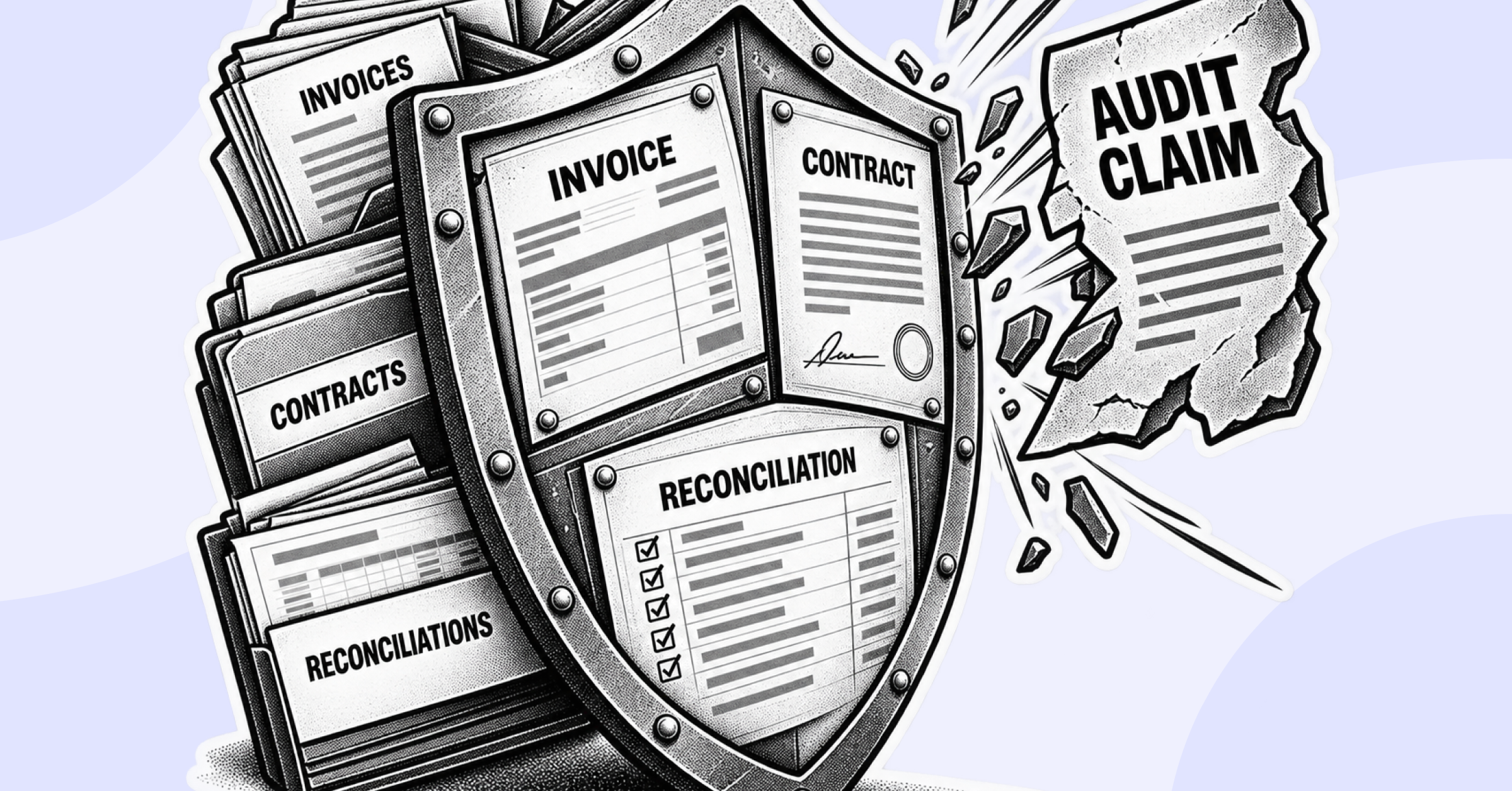
- The single biggest defense is documentation: trade deal terms, proof of delivery, invoices, and promotional agreements need to be retrievable by SKU, customer, and date range, not scattered across email threads and spreadsheets.
- A formal, board- or CEO-approved post-audit policy that sets time limits (commonly 12 to 24 months), required documentation standards, and an escalation path gives the deductions team leverage to reject unsupported claims instead of settling under pressure.
- Claims should be validated line by line against source documents rather than settled in lump sums, since bundled settlements make it easy for duplicate or invalid line items to slip through.
- Deduction management technology that centralizes documents, automates matching against claims, and tracks resolution status shortens the response window and reduces the write-off rate on claims that should have been disputed.
Retailers and distributors run post-audit programs to recover money after the fact, and the claims that come out of them can look nothing like the original invoice. A shortage claim might reference a delivery from 18 months ago. A pricing claim might cite a promotional agreement that was never formally documented. By the time the claim lands on an AR desk, the person who negotiated the original deal may have left the company, and the paperwork may not exist in a form anyone can quickly locate.
This is where most of the damage happens, not because the underlying claim is usually valid, but because the supplier cannot prove it is not. Third-party auditors are typically compensated on a contingency basis tied to what they recover, so the incentive is to file broadly and let the vendor’s own inefficiency do the rest. Companies that treat every post-audit claim as a negotiation, rather than a matter to be verified against source documents, end up writing off money they never actually owed.
This guide covers what post-audit claims are, why they happen, how to tell a valid claim from an invalid one, and the policy, process, and technology changes that reduce both the volume and the cost of these claims over time.
A quick overview: the article walks through the definition and common types of post-audit claims, why they occur, a practical validation and dispute workflow, the policy and documentation controls that prevent them, and how Bluecopa supports this process inside Order-to-Cash.
What Are Post-Audit Claims in Accounts Receivable
Post-audit claims are a specific category of deduction. A regular deduction is typically taken at the time of payment, when a customer short-pays an invoice for a reason stated on the remittance. A post-audit claim is different: it is raised after the fact, often by a third-party audit firm working on behalf of a retailer or distributor, reviewing transactions that were already invoiced, paid, and closed.
- Timing: post-audit claims can surface months or, in some cases, up to two to three years after the original transaction, well after the invoice has been reconciled and the period closed.
- Origin: many are generated by contingency-based audit firms rather than the retailer’s own AP or merchandising team, which changes the tone and volume of the correspondence.
- Form: they typically arrive as a deduction against a current invoice, a debit memo, or a direct demand letter referencing a specific past shipment or promotional period.
- Burden of proof: in most retailer-vendor relationships, the supplier carries the burden of disproving the claim within a defined response window, commonly around 60 days, before it is treated as accepted.
The distinction matters operationally. A current-period deduction can usually be resolved against documents still in an AR team’s short-term memory: the invoice, the PO, the recent remittance. A post-audit claim forces a team to reconstruct a transaction and its supporting agreements from a much older period, which is exactly why documentation retention and retrieval become the center of the problem.
Common Types of Post-Audit Claims
Understanding what a claim is actually alleging is the first step in validating it. Post-audit claims generally fall into a small number of recurring categories.
- Pricing discrepancy claims: the retailer alleges it was billed at a higher price than the agreed contract or promotional price for a given period.
- Shortage and shipping claims: the retailer alleges it received less product than was invoiced, often tied to a specific delivery or purchase order.
- Trade promotion and rebate claims: the retailer alleges a promotional allowance, off-invoice discount, or rebate was agreed but never applied or paid.
- Cash discount claims: the retailer alleges it was entitled to an early-payment discount that was not deducted at the time.
- Price protection claims: the retailer alleges it should have received a lower price retroactively because of a price decrease announced after the original shipment.
- Compliance and OTIF penalty claims: the retailer assesses a penalty for failing to meet on-time, in-full delivery standards or other routing and labeling compliance rules, sometimes reassessed after the fact by an auditor.
Each category points to a different set of source documents needed to validate or refute it, which is why a one-size-fits-all response process tends to under-perform a category-specific one.
Why Post-Audit Claims Happen
Post-audit claims are rarely random. They tend to concentrate around a specific set of structural weaknesses on the supplier side, combined with a retailer-side incentive to recover money.
- Ambiguous trade terms: promotional and pricing agreements negotiated verbally, over email, or without SKU-level detail leave room for the retailer’s auditor to interpret the deal in its own favor.
- Duplicate and re-litigated claims: auditors sometimes reintroduce a claim that was already resolved in an earlier cycle, betting that the supplier’s records will not show the prior resolution.
- Fragmented documentation: invoices, purchase orders, proof-of-delivery records, and trade agreements living in separate systems or with separate teams make it hard to assemble a complete response quickly.
- Poor record retention: documents needed to dispute a claim from two years ago may already be archived, deleted, or held by an employee who has since left.
- Contingency-based audit incentives: third-party auditors are typically paid a percentage of what they recover, which rewards volume and aggressive interpretation over accuracy.
- Internal communication gaps: sales, finance, and customer service teams often hold different, undocumented understandings of the same deal, and an auditor exploits the inconsistency.
Industry sources that track this space commonly cite that a substantial share, sometimes cited as high as half, of post-audit claims turn out to be invalid, duplicated, or based on a misapplied policy. That figure is a useful reminder that the default response to a post-audit claim should be verification, not acceptance.
How to Validate and Diagnose a Post-Audit Claim
Before deciding whether to pay, dispute, or escalate a claim, the deductions team needs a consistent diagnostic process. Treating validation as a discrete workflow step, rather than an ad hoc judgment call, is what separates teams that hold their ground from teams that settle out of exhaustion.
- Confirm completeness first: reject claims on intake if they lack the supporting documentation the retailer’s own audit agreement requires, such as a copy of the promotional agreement, delivery receipt, or pricing schedule.
- Match against the original transaction: pull the specific invoice, purchase order, proof of delivery, and any trade agreement tied to the claimed period, and compare line by line rather than accepting the auditor’s summary figure.
- Check for duplication: search prior claim and resolution records for the same customer, time period, and claim type to catch claims that were already settled or previously rejected.
- Verify the time window: compare the claim date against the company’s internal policy on how far back a claim can reach, and flag anything outside that window for automatic rejection or escalation.
- Isolate valid from invalid line items: where a claim bundles multiple line items together, split out and resolve each one individually instead of accepting or rejecting the claim as a lump sum.
- Document the resolution: whatever the outcome, log the decision, the supporting evidence, and the responding party so the same claim cannot be successfully re-filed later.
Building a Post-Audit Claims Policy and Response Process
A documented, formally approved policy is what gives an AR team standing to push back on a claim rather than negotiating from a position of uncertainty. This policy should exist independently of any single claim and be applied consistently across customers and audit firms.
- Set a claim time limit: cap the allowable retroactive window, commonly in the 12 to 24 month range, and require claims older than that to include additional justification before they are even reviewed.
- Define documentation requirements: specify exactly what evidence a claim must include to be considered complete, and reject incomplete claims at intake rather than during a lengthy review.
- Assign a dedicated response owner: route post-audit claims to a specific team or individual rather than letting them fall into general AR queues, since these claims need specialized handling and consistent recordkeeping.
- Set escalation triggers: define at what dollar threshold or claim volume a dispute moves from the deductions team to the customer’s own AP or merchandising contact, bypassing the third-party auditor.
- Standardize communication: keep all correspondence with auditors and retailers in writing and centrally logged, so there is a clear record if a claim needs to be escalated or challenged later.
- Get executive sign-off: having the policy formally approved (commonly by the CFO or controller) gives the team internal authority to hold the line on rejections rather than defaulting to settlement.
Preventing Post-Audit Claims Before They Occur
Handling claims well after they arrive matters, but the lower-cost fix is reducing how many valid-looking claims get filed in the first place. Prevention mostly comes down to tightening the documentation and communication practices that create ambiguity in the first place.
- Document trade deals at SKU level: record promotional pricing, quantities, effective dates, and expiration terms explicitly, rather than relying on general account-level agreements.
- Centralize documentation: maintain a single, retrievable repository for invoices, POs, proof of delivery, and trade agreements so a claim from any period can be answered quickly.
- Align sales and finance on deal terms: make sure the team booking a promotional agreement and the team reconciling deductions are working from the same documented terms, not separate verbal understandings.
- Run internal audits proactively: periodically review high-risk customers and promotion types before a third-party auditor does, so issues are caught and resolved internally rather than surfacing as an external claim.
- Standardize and simplify deal structures: the more variation there is across customer-specific pricing and promotional terms, the more surface area exists for a claim to exploit ambiguity.
- Maintain a complete audit trail: every price change, promotional approval, and delivery confirmation should be traceable back to a specific decision and date, not reconstructed after the fact.
Role of Deduction Management Technology in Post-Audit Claims
Manual, spreadsheet-based deduction handling struggles specifically with post-audit claims because the relevant documents are old, scattered, and time-consuming to retrieve under a 60-day response deadline. Purpose-built deduction management and reconciliation technology addresses this in a few concrete ways.
- Centralized, searchable documentation: trade agreements, invoices, proof of delivery, and prior claim resolutions are stored in one system and retrievable by customer, SKU, or date range instead of by memory.
- Automated matching: claims are automatically matched against the original transaction data, flagging discrepancies and duplicate claims without a manual line-by-line search.
- Workflow and audit trail: every claim’s intake, validation, and resolution status is tracked with a full history, which both speeds up response time and creates the evidence trail needed for escalation.
- Policy enforcement: time-limit and documentation-completeness rules can be applied automatically at intake, rejecting non-compliant claims before they consume analyst time.
- Reporting and root-cause tracking: claim volume and outcomes by customer and category become visible over time, making it possible to see which promotional structures or customers generate recurring, and often invalid, claims.
How Bluecopa Helps with Post-Audit Claims
Post-audit claims sit squarely inside Order-to-Cash, and handling them well depends on the same underlying problem Bluecopa is built to solve: getting transaction data, supporting documents, and resolution workflows onto one platform instead of scattered across email, spreadsheets, and disconnected point tools.
- Samyx Extract pulls structured data out of the documents that matter for a post-audit claim, invoices, delivery confirmations, remittance advices, and trade agreements, so a claim from 18 months ago can be answered from retrievable, structured records instead of a manual document hunt.
- Samyx Recon matches claimed amounts against the original invoice, purchase order, and payment data automatically, surfacing discrepancies and duplicate claims the way a manual line-by-line review would, but without the analyst hours.
- Samyx Build lets finance teams codify the post-audit claims policy itself, documentation requirements, time-limit rules, and escalation thresholds, as workflow and policy-as-code, along with segregation of duties on who can approve a claim settlement versus who can reject one.
- Because this data flows into Bluecopa’s Order-to-Cash module on one platform, deduction and claims data connects directly to cash application, collections, and AR reporting, rather than sitting in a bolted-on deductions point solution that never talks to the rest of the AR stack.
For enterprise finance teams managing high deduction volume across retail and distributor channels, this means faster claim validation, a documented audit trail for every resolution, and fewer claims settled by default simply because the supporting evidence was hard to find in time.
Related reading: Accounts Receivable Software for Enterprise Teams and Debt Collection Software Buying Guide
Frequently Asked Questions
1. What is the difference between a post-audit claim and a regular deduction?
A regular deduction is typically taken at the time of payment against a current invoice, for a reason the customer states on the remittance. A post-audit claim is raised later, often by a third-party auditor, against a transaction that was already invoiced, paid, and closed, sometimes months or years earlier.
2. Who typically files post-audit claims?
Post-audit claims are commonly filed by third-party audit firms working on behalf of a retailer or distributor, often compensated on a contingency basis tied to how much they recover, in addition to claims the retailer’s own AP or merchandising team files directly.
3. How far back can a post-audit claim reach?
There is no universal legal limit, but claims can reach back months to a few years depending on the retailer’s audit program and contract terms. Suppliers commonly set an internal policy capping the allowable window, often between 12 and 24 months, and require additional justification for anything older.
4. What documentation is needed to dispute a post-audit claim?
Typically the original invoice, purchase order, proof of delivery, and any trade promotion or pricing agreement covering the claimed period. Claims lacking equivalent documentation from the auditor can often be rejected on completeness grounds before a full review is needed.
5. Should post-audit claims be settled in a lump sum?
No. Settling in a lump sum makes it harder to separate valid line items from invalid or duplicate ones. Validating and resolving each line item individually reduces the risk of paying for claims that should have been rejected.
6. How can a company reduce the number of post-audit claims it receives?
The most effective levers are documenting trade deals at the SKU level with clear expiration dates, keeping sales and finance aligned on deal terms, maintaining a centralized and retrievable document trail, and running internal audits on high-risk customers before an external auditor does.