

Key Takeaways
- Record-to-report (R2R) automation at global enterprises is not one project. It spans transaction capture, reconciliation, intercompany eliminations, consolidation, journal entries, and reporting, and each layer tends to get automated on its own timeline.
- Multi-entity, multi-ERP organizations face structural R2R problems that single-entity companies don’t: fragmented chart of accounts across ERPs, intercompany mismatches across currencies and time zones, and a control environment that has to hold up entity by entity, not just at the consolidated level.
- Gartner’s 2025 AI in Finance survey found 59% of finance functions now use AI in some form, up from 58% in 2024 and 37% in 2023, with accounts payable automation and error/anomaly detection among the top verified use cases. That data point describes adoption of AI in finance broadly, not a specific R2R benchmark, and is presented here as directional context rather than an R2R-specific statistic.
- Global Capability Centers (GCCs) and shared services hubs are increasingly where R2R automation actually gets designed and run, since they already centralize transaction volume across entities and are measured on cycle time and cost per transaction.
- The organizations further along in R2R automation maturity tend to have moved past rules-based, template-matching tools toward AI-native platforms that handle unstructured and semi-structured data (SAP, Oracle, NetSuite, regional ERPs, bank files, spreadsheets) without a separate integration project per entity.
- A continuous or “soft” close approach, where reconciliation and controls run throughout the month instead of compressing into a hard month-end sprint, is the direction leading organizations are moving, though most enterprises still run a hybrid of continuous checks plus a formal close calendar.
Global finance teams don’t struggle with record-to-report because the process itself is unfamiliar. Every controller knows the sequence: capture transactions, reconcile accounts, eliminate intercompany activity, consolidate entities, book journal entries, close the books, and report out. The struggle is scale and fragmentation. A company running twelve entities across four ERPs, six currencies, and three time zones is running the same R2R process twelve times in parallel, with intercompany activity threading through all of them, and a controls framework that has to hold at every layer.
That’s the reality behind the question of how global organizations are actually automating R2R in practice. It’s less about a single tool replacing a spreadsheet and more about which layers of a genuinely complex, multi-entity process get automated first, in what order, and with what kind of technology (rules-based versus AI-native) at each step. Global Capability Centers add another dimension: many large enterprises now run their R2R operations out of a centralized shared-services hub, which changes both the automation priorities and the way success gets measured.
This piece looks at what’s structurally hard about R2R at global scale, what’s actually being automated across the cycle today, how AI-native approaches differ from older rules-based and RPA tooling, where GCCs fit into the automation strategy, and a practical way to sequence a rollout without waiting for a single “big bang” implementation.
A quick overview: this article covers why R2R is uniquely hard for multi-entity global organizations, what’s actually being automated across the R2R cycle, AI-native versus rules-based automation approaches, the role of Global Capability Centers, a practical rollout sequence, and the ROI and risk considerations enterprise finance leaders should weigh before investing.
Why Is Record-to-Report Harder for Global, Multi-Entity Organizations
R2R is a well-defined process on paper: transaction capture, reconciliation, journal entries, consolidation, and reporting. What changes at global scale isn’t the process definition, it’s the number of moving parts that have to stay synchronized across it.
- Multiple ERPs and charts of accounts. Enterprises built through acquisition, regional expansion, or long operating histories rarely run one ERP. SAP in one region, Oracle in another, NetSuite or a regional system in a third is common. Each entity’s chart of accounts, transaction coding, and close calendar can differ slightly, which makes a single consolidated close depend on reconciling structural differences before the numbers even get compared.
- Currency and intercompany complexity. Every cross-entity transaction (a shared service charged back, inventory transferred between subsidiaries, a loan between a parent and a subsidiary) has to be recorded twice, in two currencies, on two books, and then eliminated correctly at consolidation. A mismatch anywhere in that chain shows up as an out-of-balance intercompany account that someone has to manually trace.
- Time zone and handoff friction. A GCC-based team in India closing books for entities in the Americas and EMEA is working across a close calendar that spans time zones. Questions raised at the end of one team’s day sit unanswered until the next team logs in, which stretches cycle time even when the underlying work is straightforward.
- Controls that have to hold at the entity level, not just the group level. SOX and equivalent regulatory frameworks require controls and segregation of duties to be demonstrable per entity, not just at the consolidated group. Multiply a controls framework by a dozen entities and the audit and evidence burden multiplies with it.
- Data volume and format variety. Bank statements, ERP exports, vendor invoices, and intercompany confirmations arrive in different formats from different systems. Manually normalizing that data before it can even be matched is often the single biggest time sink in a global close.
None of this means R2R is conceptually different at scale. It means every step in the process runs into multiplication: more systems, more currencies, more handoffs, more controls to evidence, applied to the same underlying five-step process.
What Is Actually Being Automated Across the Record-to-Report Cycle
“Automating R2R” is often used as a single phrase, but in practice organizations automate specific layers of the cycle, usually in this rough order of maturity.
- Reconciliation and matching. This is typically the first and highest-volume automation target: matching transactions across bank statements, sub-ledgers, and the general ledger without a person manually tying out line items. At enterprise volume, this means matching millions of records across formats and entities, not a few hundred lines in a spreadsheet.
- Data capture and normalization. Before matching can happen, data has to be extracted from PDFs, bank files, ERP exports, and emailed statements into a consistent structure. Automating this step removes the manual re-keying that otherwise happens before reconciliation even starts.
- Intercompany transaction matching and elimination. Automating the matching of intercompany charges, transfers, and balances across entities, and flagging mismatches before consolidation, removes one of the most manual and error-prone steps in a multi-entity close.
- Journal entry generation and review. Recurring, rules-based journal entries (accruals, allocations, standard adjusting entries) are increasingly generated automatically from underlying data rather than manually keyed each period, with a human reviewing exceptions rather than drafting every entry.
- Consolidation. Rolling up entity-level results into group financials, applying elimination entries, and handling currency translation is being automated end-to-end in more mature organizations, rather than assembled manually in a consolidation workbook each period.
- Controls and segregation of duties. Enforcing who can approve what, at what threshold, per entity, and generating the audit evidence automatically (rather than screenshotting workflows after the fact) is a growing automation target, particularly for organizations under SOX or equivalent frameworks.
- AI-powered variance analysis and reporting. Once the close is complete, systems increasingly aggregate data across entities and formats automatically, run a preliminary variance analysis against budget or prior period, and draft the first pass of management commentary, letting the finance team focus on interpreting exceptions rather than assembling the numbers behind them.
- Management reporting. Standard management reports are generated directly from the closed data set instead of being rebuilt manually in spreadsheets each cycle, which closes the loop between close and reporting.
Most global organizations don’t automate all of this at once. Reconciliation and data capture tend to come first because they’re the highest-volume, most mechanical steps. Consolidation and controls automation tend to follow once the underlying data flow is trustworthy.
AI-Native Automation vs. Rules-Based and RPA Approaches for R2R
A meaningful distinction in how R2R gets automated today is between older rules-based automation (including robotic process automation, or RPA) and newer AI-native approaches.
- Rules-based and RPA tools automate the mechanics of a fixed process. They’re effective when the underlying data format and matching logic don’t change: a bot that logs into a portal, downloads a file, and applies a fixed matching rule. They struggle when formats vary, when a new entity or ERP is added, or when the matching logic needs judgment (a near-match with a slightly different reference number, for instance).
- AI-native platforms are built to handle variability rather than assume a fixed format. They can match transactions using pattern recognition across inconsistent formats and references, extract structured data from unstructured documents (a scanned invoice, a bank statement PDF, an email confirmation) without a separate integration built for each source, and improve matching accuracy as they process more of an organization’s specific data patterns.
- The practical difference shows up when a new entity, ERP, or data source is added. A rules-based system typically needs a new integration or rule set built for that source. An AI-native system is designed to generalize across new formats without a bespoke build for every entity, which matters directly for organizations that are still consolidating ERPs or adding entities through acquisition.
- Exception handling looks different too. Rules-based tools flag anything that doesn’t fit the rule, often producing a high volume of exceptions that still need manual review. AI-native matching is designed to resolve more of the “near match” cases automatically and surface a smaller, more genuinely exceptional set of items for human review.
This isn’t an argument that RPA has no place in R2R. It’s still useful for genuinely fixed, repetitive tasks. But for organizations running R2R across many entities and formats, where the data itself is the variable, AI-native reconciliation and data capture are what’s actually closing the gap that rules-based tools left open.
How Global Capability Centers Factor Into R2R Automation Strategy
Global Capability Centers and shared services hubs have become a default operating model for large enterprises running finance operations across many entities, and they change how R2R automation gets prioritized in a few specific ways.
- GCCs concentrate transaction volume, which makes automation ROI easier to justify. A shared services team processing reconciliation, intercompany matching, or journal entries for dozens of entities at once sees the time savings from automating a single workflow multiplied across every entity that workflow serves.
- GCCs are typically measured on cycle time and cost per transaction, which are exactly the metrics automation is meant to move. Because GCCs already operate against efficiency KPIs, automation initiatives inside them tend to have clearer success criteria than automation efforts embedded inside a single business unit.
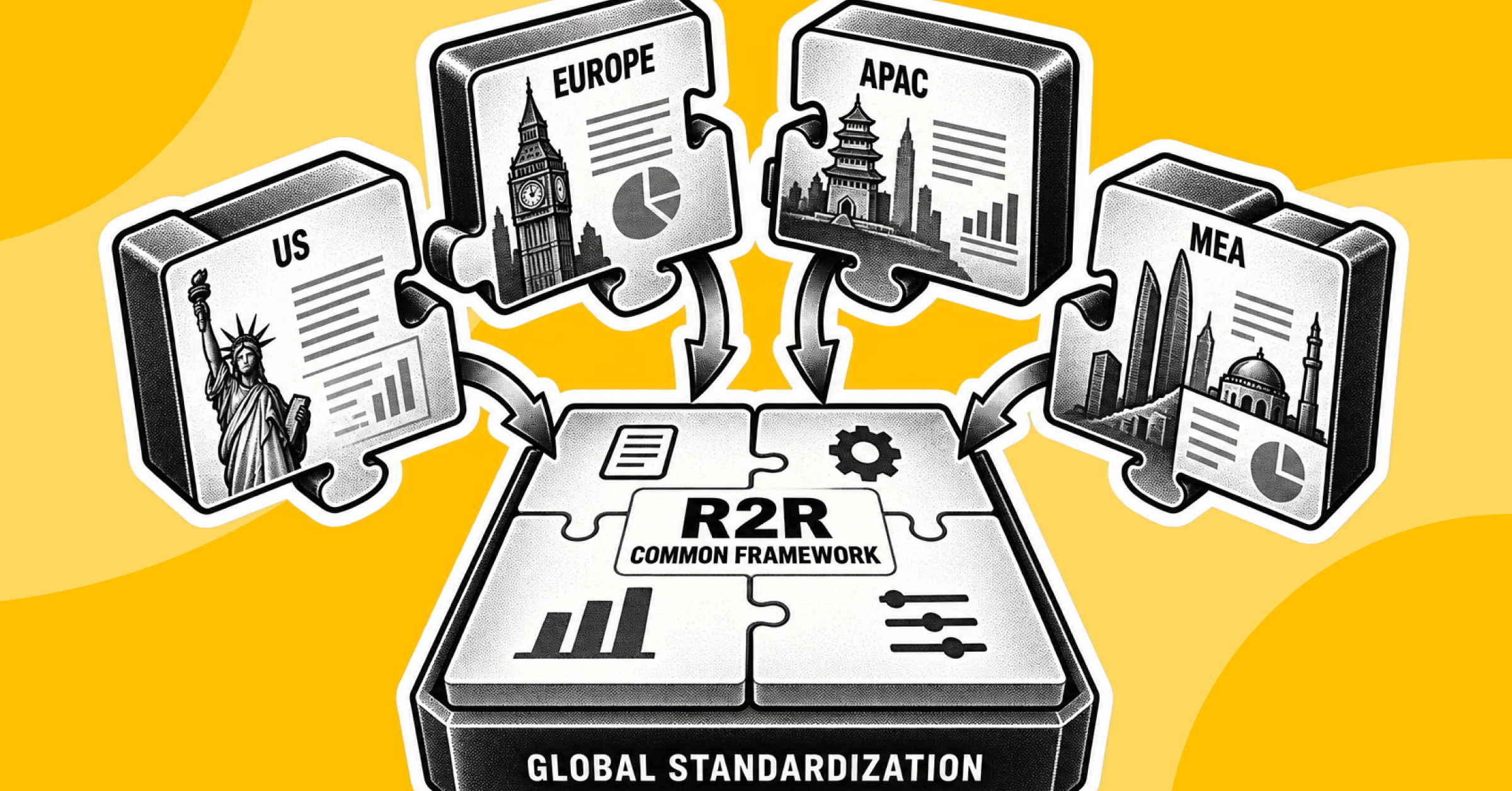
- Standardization becomes a prerequisite, not an afterthought. A GCC serving multiple entities across different ERPs has a direct incentive to push for standardized processes and a common automation platform, since running a different manual workaround per entity defeats the purpose of centralizing the work in the first place.
- A single data and control layer across entities matters more inside a GCC model than in a decentralized one. When one team is responsible for close across many entities, a platform that unifies reconciliation, R2R, and controls data in one place (rather than a different point tool stitched together per region) directly reduces the operational overhead of running the center.
- GCCs are often where automation gets piloted before it’s rolled out group-wide. Because a GCC already touches multiple entities, it’s a natural proving ground for an automation approach before extending it to entities still running R2R locally.
For organizations already operating or building out a GCC, R2R automation strategy and shared-services strategy aren’t separate conversations. The automation approach that works for a centralized team serving many entities is usually the same approach worth extending to the rest of the organization.
How to Automate Record-to-Report at Enterprise Scale: A Practical Rollout Sequence
Enterprises rarely automate R2R in a single implementation. A practical sequence, based on where the highest manual effort and highest error risk typically sit, looks like this.
- Start with reconciliation and data capture. This is usually the highest-volume, most mechanical part of R2R, and the place where AI-native matching produces the fastest, most measurable time savings. It’s also lower-risk to automate first because reconciliation output feeds into, rather than replaces, the judgment calls further down the process.
- Standardize data structure across entities before automating consolidation. Consolidation automation depends on entity-level data already being in a consistent, reconcilable state. Automating consolidation before reconciliation and data capture are solid tends to just move manual cleanup downstream rather than remove it.
- Automate intercompany matching once entity-level reconciliation is stable. Intercompany elimination depends on both sides of a transaction being correctly matched and reconciled first, so it’s a natural second step rather than a starting point.
- Layer in controls and segregation-of-duties automation as the data flow stabilizes. Automated controls are only as good as the underlying process they’re monitoring. Building controls automation on top of a still-manual reconciliation process usually just automates the appearance of control rather than the substance of it.
- Extend to journal entry generation and management reporting last. These steps depend most heavily on everything upstream being accurate, so they benefit most from automation once the earlier layers are trustworthy.
- Treat the GCC or shared-services team as the natural pilot group. Since a GCC already touches multiple entities and is measured on cycle time, piloting automation there before a group-wide rollout gives a faster, cleaner read on what’s working before scaling it further.
This sequence isn’t a fixed rule. Organizations further along in ERP consolidation or with fewer entities may be able to move faster on consolidation and controls automation earlier. But reconciliation and data capture consistently show up as the sensible starting point because they carry the least dependency on everything else being fixed first.
ROI and Risk Considerations for Enterprise R2R Automation
Global finance leaders evaluating R2R automation are weighing a real trade-off, not a guaranteed win, and it’s worth being direct about both sides.
- The clearest, most verifiable ROI shows up in reconciliation and data capture time. Manual matching and manual data entry are the most measurable time sinks in R2R, and they’re also where automation has the most established track record of reducing hours spent per cycle.
- Gartner’s 2025 AI in Finance survey found that organizations further along in AI adoption are two to three times more likely to report moderate or high impact from it, compared to organizations just starting out. That’s a general finance-AI adoption finding, not an R2R-specific benchmark, but it points to a broader pattern: automation ROI compounds with maturity rather than appearing fully formed after a first pilot.
- The risk that gets underweighted is control integrity during the transition. Moving from manual to automated reconciliation or journal entries changes who is accountable for what, and where evidence for an audit comes from. Organizations that automate a process without also rebuilding the control narrative around it can end up with a faster close that’s harder to defend in an audit.
- Change management across a GCC and distributed entities is a real cost, not a footnote. Automating a process that a shared-services team and multiple regional finance teams all touch requires getting all of them onto the same workflow, which takes longer than the technology rollout itself in most cases.
- A hybrid close calendar is the realistic near-term state for most enterprises, not a fully continuous close. Even organizations automating heavily in reconciliation and intercompany matching tend to still run a formal close calendar with defined cutoffs, using continuous automation to reduce the workload inside that calendar rather than eliminate the calendar itself.
The honest takeaway is that R2R automation at global scale pays off fastest in the mechanical, high-volume layers (reconciliation, data capture, intercompany matching) and needs more deliberate planning, not less, in the layers that carry audit and control weight.
How Bluecopa Helps Global Organizations Automate Record-to-Report
Bluecopa is built for the exact structural problem this article describes: enterprises running R2R across many entities, ERPs, and currencies, often through a GCC or shared-services model, where stitched-together point tools per entity create more overhead than they remove.
- A unified data layer across reconciliation, R2R, O2C, and P2P, instead of a separate tool per entity or per process. For a global organization running R2R across a dozen entities, having reconciliation, close, and downstream O2C/P2P data live on one platform removes the reconciliation-of-the-reconciliation-tools problem that stitched-together point solutions create.
- Samyx Recon performs AI-native matching at scale, processing more than 5 million records per hour, which is built for exactly the high-volume, multi-format matching problem described above: bank files, ERP exports, and intercompany transactions across entities and currencies, matched without a separate rule set per source.
- Samyx Extract captures structured data from unstructured and semi-structured sources (PDFs, bank statements, vendor documents, emailed confirmations) across entities and formats, addressing the data normalization step that otherwise sits ahead of reconciliation as manual work.
- Samyx Build applies policy-as-code controls and segregation-of-duties enforcement across a multi-entity control environment, so controls scale with the number of entities instead of being rebuilt manually for each one, which matters directly for organizations running SOX or equivalent compliance across jurisdictions.
- Purpose-built relevance to GCC and shared-services structures: a single platform that a centralized team can run reconciliation, close, and controls through for every entity it serves, rather than maintaining a different manual workaround per region.
Two enterprise results are directly relevant to this topic. Yatra achieved 7x faster AR reconciliation and a 90% faster month-end close after moving to Bluecopa, and HackerEarth cut reconciliation errors by 60%. Both point to the same underlying pattern this article describes: the fastest, most measurable wins in R2R automation show up first in reconciliation and close cycle time, which is exactly where a global, multi-entity organization should expect to see impact first.
Bluecopa’s platform is built for enterprise finance teams, not mid-market operations, which matches the scale and complexity this article has focused on throughout.
For related reading, see how to automate bank reconciliation and what continuous close software actually does (both internal link suggestions, flagged for verification against the live sitemap before publishing).
Frequently Asked Questions
1. What does “record-to-report” (R2R) actually cover?
R2R spans the full cycle from transaction capture through reconciliation, journal entries, intercompany elimination, consolidation, close, and management reporting. It’s the process that turns raw financial transactions into audited, reportable financial statements.
2. Why is R2R harder for global organizations than for a single-entity company?
The process steps are the same, but global organizations run them in parallel across multiple entities, ERPs, currencies, and time zones, with intercompany activity connecting all of them and controls that have to hold at the entity level, not just the consolidated group level.
3. What’s the difference between rules-based automation and AI-native automation in R2R?
Rules-based tools, including RPA, apply a fixed matching or process logic and need a new rule or integration built whenever the underlying data format changes. AI-native platforms are designed to handle variable, unstructured, and semi-structured data across formats without a bespoke build per source, which matters for organizations adding entities or consolidating ERPs.
4. Where do Global Capability Centers fit into R2R automation?
GCCs and shared-services hubs already centralize R2R work across multiple entities, which makes automation ROI easier to justify and gives organizations a natural pilot group before a group-wide rollout. They’re typically measured on cycle time and cost per transaction, the same metrics R2R automation is meant to improve.
5. Is continuous close replacing month-end close entirely?
Not yet, for most enterprises. The more common near-term pattern is a hybrid: continuous reconciliation and control checks running throughout the month, layered under a formal close calendar with defined cutoffs, rather than eliminating the calendar altogether.
6. Where should a global organization start automating R2R?
Reconciliation and data capture are the typical starting point, since they carry the highest manual volume and the least dependency on other parts of the process being fixed first. Intercompany matching, consolidation, controls, and reporting automation tend to follow once the underlying data flow is reliable.